Posts

Where the Wild Things Are
Image
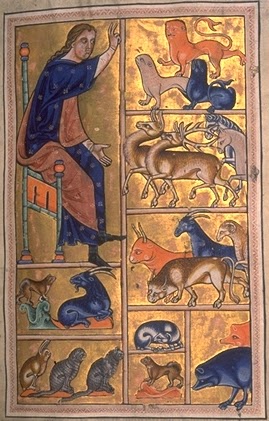
Adam names the animals     The sky is overcast with dark grey clouds and the persistent drizzle is quickly turning into a downpour. It is the twelfth century in England and Emily is sitting next to her father, watching him work. At sixteen, she is already quite an accomplished artist and considers herself very fortunate to be the daughter of one of the most talented and respected illuminators in England. Her father is creating an ‘Illuminated Manuscript’. Emily knows the patron is extremely wealthy and suspects he may be from the royal family. Illuminated manuscripts were manuscripts decorated in real gold or silver and were fairly common in the medieval ages. They were painted on the best quality parchment called 'Vellum' and were written in Latin. The text was usually written first by a scribe and then given to the illuminator. Emily watches her father as he applies the gold to the painting. She knows the complex process well by now, the gold leaf pieces a...
The Dual Nature of Christ

Image
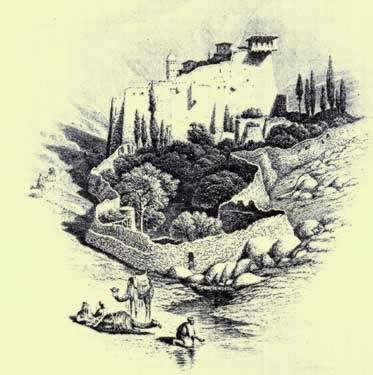
As the group of pilgrims move slowly along the endless desert on their mules, Egeria is struck by the sheer inhospitality of the terrain. She feels humbled when she thinks of Moses, and how he had led his people through this very desert for forty years. It is the sixth century AD, and the pilgrims have travelled for many weeks to reach St. Catherine’s Monastery at the base of Mt.Sinai in Egypt. An old monk leads the tired pilgrims through the monastery. As Egeria follows her people, her eyes suddenly fall on an icon of Christ, she is instantly drawn towards it. This painting of Christ as the Pantocrator, which in Greek means ‘Ruler of All’ is regarded as one of the earliest examples of Byzantine Iconography (painting). Believed to have been painted by a highly accomplished artist from Constantinople (Turkey) during Emperor Justinian’s reign, this is a 33X18cm Encaustic painting on wood. Encaustic painting also known as hot wax painting, involves the use of heated beeswa...

Night - Shining White

Image
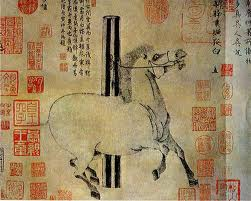
The setting sun is like a fireball in the sky. There is a gentle breeze and the soft undulating hills of ancient China, look like a green carpet has been spread over them. Suddenly, as if out of nowhere, a stunning, pure white steed appears like an apparition on the horizon. As the majestic horse canters freely every muscle in his body ripples and his beautiful mane blows in the wind. This spirited steed is 'Night – Shining White'. He is the favourite imperial stallion of Emperor Xuanzong, of the Tang dynasty. There is something more than the sheer physical beauty of this animal; it is his spirit, which epitomizes the Chinese myth about imported ‘celestial steeds' that ‘sweat blood’ are really dragons in disguise. It is the eighth century, and Tang China is one of the greatest empires in the medieval world. Emperor Xuanzong, is referred to as the ‘brilliant monarch ‘and his reign is rightfully ranked as the classical period of Chinese art and literature.     Han...

A Picture in Over a Million Pieces

Image
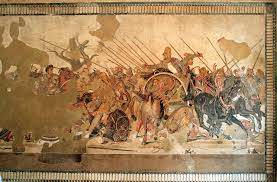
It is a little after eight p.m, on a cool summer evening, when the first guests start arriving. The venue is the aristocratic, ‘House of the Faun’ Pompeii, named after a statue of a dancing faun in the courtyard. It is 300 BC and the ancient city is at its glorious peak. The parties at this residence are famous for their extravagance and as always,the guest list is extremely high brow.   As the guests walk from the outer courtyard towards the inner courtyard they slow down and stare in awe at a magnificent floor mosaic surrounded by columns. The mosaic depicts the battle between Alexander the great and Darius the king of Persia.   This ambitious work of art is 8ft. 11 inches in height and 16 ft. 9 inches in length. It is made with a million and a half pieces of tiny coloured tiles of stone and glass called 'tesserae', arranged in gradual curves known as ‘worm work ‘because they seem to replicate the slow motion of a crawling worm. The contrast between the stone and gla...

Book of the Dead

Image
As the sun sets over the Nile, there is a feeling of calm serenity over the river. Not far from here is a group of very busy men, consisting of the head scribe and his assistants. The year is 1275 BC; they are working on a scroll made of papyrus; drawing, painting and writing, creating a Book of the Dead, with different symbols, magic spells and rituals for a very well-known and respected scribe called Hunefer. The Book of the Dead was an ancient Egyptian funeral text written to assist a dead person’s journey into the afterlife. These texts, written in hieroglyphic script on scrolls of papyrus were buried with the dead in their coffins. The texts and images were magical as well as religious and the whole idea was to protect the dead person on his journey. In case you’re wondering, not all these texts were the same; in fact each was unique and contained a different mixture of spells and rituals. The Book of the Dead was produced to order by the scribes. They were commissioned by pe...
I must have been nine or ten years old when I saw my first Van Gogh. It was a picture of, 'The Starry Night' on a postcard and I was completely in awe of it. Unaware of the name of the painting at that time, I was just so fascinated by the colors the way in which the sky had been painted. There was so much movement in the drawing. Were those clouds? Stars? Lights?  I wanted to know, why the artist painted the picture this way? Was he in a hurry? Or maybe excited about something? I copied it and put it up in my room. Of course, it was much later that I found out the reasons for those frenzied strokes and the tragedy of this great artists life. But that's for later on in our story. I hope as we go back in time together and embark on this exciting journey, you too will feel the same passion for these artists and their work as I do. So the next time you visit a new place, or have a couple of hours to kill, ditch the mall and go to the local museum ...